 3D Printer FYI
Most oversized-print problems end with a split model and a glue joint. Ivan Miranda and Jón Schone had a different item on their project list: make a treadmill into a printer.
In Miranda’s original project description, he explains that the idea had been on both their lists, that they agreed at Formnext to pursue it, and that they set aside a few days to build it together. He describes a result better than expected, acknowledges issues during the build, and frames a one-piece kayak as the next ambition. That description records an experiment and its next question. It does not establish a commercial machine specification.
Original video by Ivan Miranda, with Proper Printing. Watch the creators’ build above.
Change the shape of the constraint
A fixed bed gives the job a bounded footprint. A belt architecture lets the work advance through the machine. That changes the planning problem: width and clearance still matter, and the emerging part needs somewhere to go.
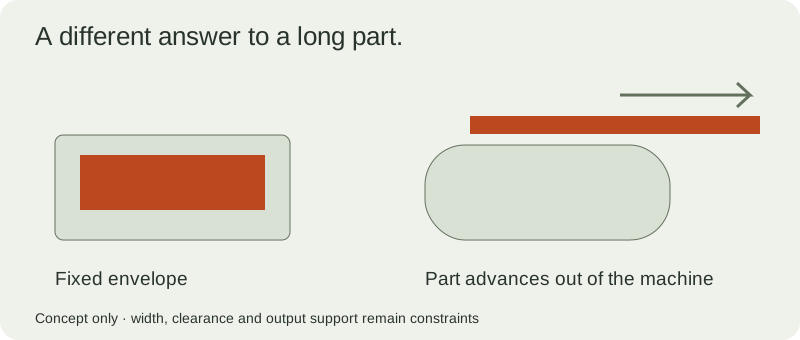
This diagram explains the architectural idea. It is not a dimensional drawing of their printer. No exact build envelope, speed or usable part length is inferred from the video thumbnail.
For your own job, write down the constraint before choosing the exciting solution. Is the part too long in one orientation? Could it be split at a useful joint? Does the requirement actually demand a continuous piece? What must support it as it exits?
The printer selector helps with ordinary documented envelopes. Treat unusual geometry and operating modes explicitly. A machine that changes the geometry deserves more than a suspiciously enormous number in a Z field.
Keep the prototype separate from the promise
Miranda’s description acknowledges problems but does not identify a complete failure log. We have not turned secondary recaps into a list of verified component failures, or a reported demonstration into an independent throughput benchmark.
That boundary makes the project more interesting. A prototype can establish that a mechanism is worth pursuing while leaving durability, output quality and operational convenience unanswered. The next iteration gets a useful question instead of an imaginary clean bill of health.
Borrow the method, even if you keep the bed
Take a project you have postponed because it does not fit. Make a three-column worksheet: the present constraint, a possible architectural change, and the smallest test that could reject the idea. “Buy bigger” is one candidate. Splitting the part, changing its orientation or redesigning the assembly may be others.
If you redesign a joint, use a fit study before committing the full print. If you change a slicing workflow, inspect supported commands and interpretation gaps in the G-code Microscope. Neither tool validates an experimental machine; each helps keep one part of your reasoning visible.
A treadmill is a wonderfully excessive answer to a print-bed problem. The reusable lesson is surprisingly economical: spend the experiment on the constraint that actually matters.
Continue: Choosing an FDM printer · Ivan Miranda creator profile.
Sources
- Treadmill printer — Ivan Miranda with Proper Printing — reviewed 2026-09-15.
- Proper Printing — Jón Schone — reviewed 2026-09-15.